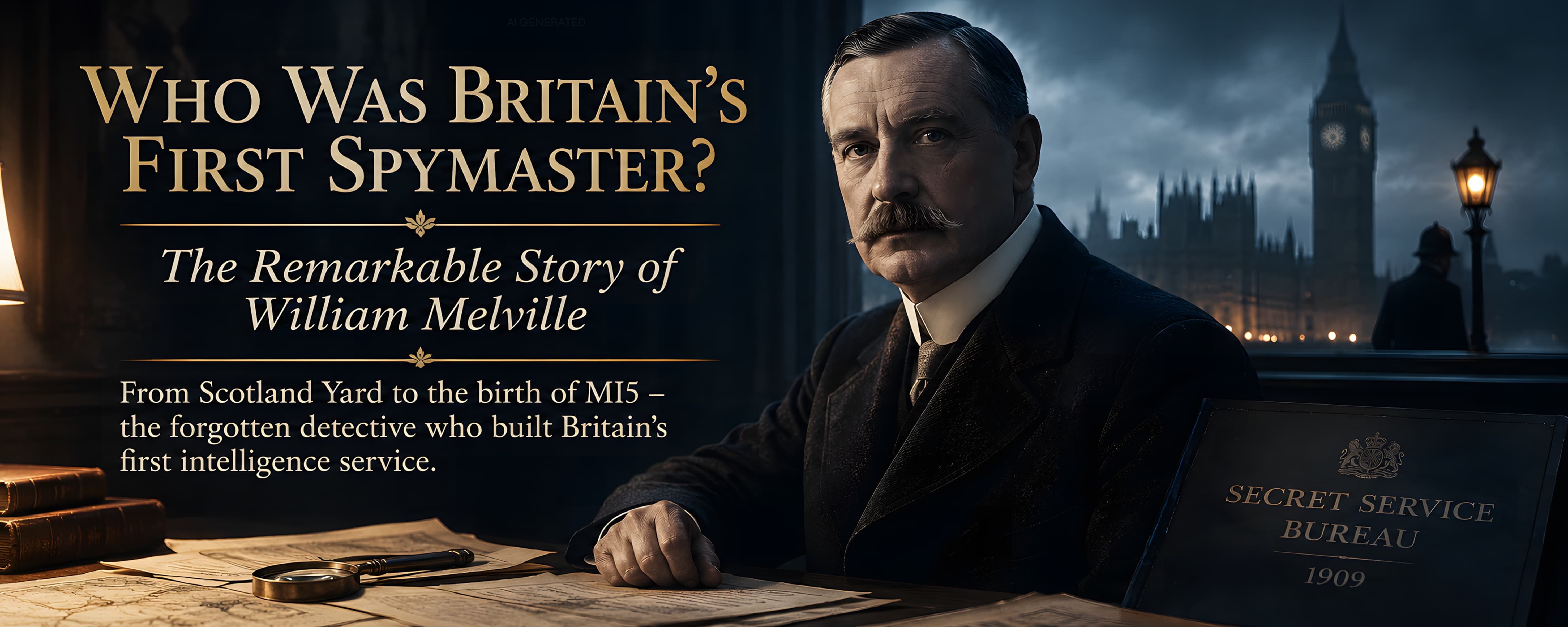
Who Was Britain's First Spymaster?
Introduction
Most people believe Britain's first spymaster was Sir Vernon Kell, the founding head of MI5. In fact, the story begins several years earlier with an Irish detective from County Kerry whose extraordinary career took him from Scotland Yard to the heart of Britain's secret intelligence machinery. His name was William Melville, and without him, MI5 might never have existed.
The Fenian Detective
William Melville was born in County Kerry, Ireland, in 1850. After moving to England as a young man, he joined the Metropolitan Police in 1872, beginning what would become one of the most remarkable - and least celebrated - careers in British intelligence. At the time, London was the largest city in the world, its crowded streets home to both immense wealth and grinding poverty. It was also becoming a refuge for political exiles, revolutionaries and anarchists from across Europe, many of whom brought their causes - and sometimes their violence - with them.
Melville quickly gained a reputation as an unusually capable detective. He possessed a remarkable memory, spoke several languages and was known for his patience and attention to detail. Unlike many Victorian detectives, he relied less on dramatic arrests than on careful observation, cultivating informants and quietly gathering evidence over long periods. These qualities would later make him ideally suited to the world of espionage, where success depended as much on discretion as on courage.
His Irish background proved an unexpected advantage. During the 1880s, Britain faced an increasing campaign of violence from Fenian organisations seeking Irish independence. Bomb attacks in London and other British cities caused widespread alarm, prompting the Metropolitan Police to establish what would become Special Branch. Melville's knowledge of Irish politics and culture enabled him to infiltrate extremist groups and win the confidence of men who would never have trusted an English detective. By the end of the decade, he had become one of Scotland Yard's foremost experts on political terrorism.
Hunting Anarchists and Protecting the Crown
By the early 1880s, Melville had become one of Scotland Yard's most trusted detectives. Britain was facing a campaign of bombings organised by Irish republican extremists, known collectively as the Fenians. Their objective was simple: to force Britain to abandon Ireland by carrying the conflict to the streets of London. Railway stations, government buildings and even the Underground became potential targets. The Metropolitan Police needed men capable not only of solving crimes after they had been committed, but of preventing them altogether.
Melville excelled in this dangerous work. Rather than relying solely on surveillance, he cultivated informants and, when necessary, infiltrated extremist circles himself. He was an accomplished linguist, possessed an extraordinary memory and had a remarkable ability to gain the confidence of those he was investigating. Contemporary accounts describe him adopting different identities with ease, moving comfortably among people who had no idea they were speaking to one of Scotland Yard's senior detectives.
His Irish upbringing proved invaluable. Unlike many of his colleagues, Melville understood the politics, culture and dialects of the organisations he was pursuing. That knowledge enabled him to distinguish between constitutional Irish nationalists and those committed to violence, allowing the police to focus their attention on genuine conspirators. It also helped him earn the trust of men who would have regarded an English detective with immediate suspicion.
The success of these operations established Melville's reputation throughout government. Ministers increasingly regarded him as the man who could be relied upon to penetrate secret organisations and uncover conspiracies before they reached fruition. It was a skill that would eventually draw him beyond ordinary police work and into the shadowy world of intelligence, where the ability to obtain information quietly was often more valuable than making arrests.
Scotland Yard's Secret Weapon
By the closing years of the nineteenth century, William Melville's reputation had spread far beyond Scotland Yard. His success against Fenian terrorists was followed by investigations into anarchist organisations operating across Europe, many of which regarded London as a safe refuge. Melville developed an extensive network of informants both in Britain and overseas, exchanging intelligence with police forces on the Continent at a time when international cooperation against terrorism was still in its infancy.
His work attracted the attention of governments throughout Europe. Detectives from France, Germany, Belgium and Russia sought his advice, while visiting dignitaries increasingly relied upon Scotland Yard to provide discreet protection during state visits. Melville had become far more than a police detective. He was emerging as one of Europe's foremost experts in political security and counter-subversion.
Protecting Monarchs
Melville's reputation reached its height during the funeral of Queen Victoria in February 1901. The ceremony brought together an unprecedented gathering of European royalty, presenting an irresistible target for anarchists whose campaign of political assassination had already claimed several crowned heads across the continent.
Among those responsible for protecting the visiting monarchs was Melville himself. Working alongside police and security officials from across Europe, he coordinated measures to safeguard the procession and the assembled royalty. One of his German counterparts was Gustav Steinhauer, then a rising officer in the Prussian political police. The two men, who would later find themselves directing opposing intelligence organisations during the First World War, stood side by side in the service of peace on one of the most solemn occasions of the age.
It was a remarkable irony. Within little more than a decade, Melville would be organising Britain's intelligence operations against Germany, while Steinhauer became one of the architects of German espionage. Former colleagues had become adversaries.
The Birth of Britain's Secret Service
At the beginning of the twentieth century Britain possessed no permanent civilian intelligence organisation. Military intelligence existed in various forms, and Scotland Yard investigated crimes within Britain, but no department was responsible for systematically collecting intelligence on foreign espionage or coordinating counter-intelligence operations.
That situation was becoming increasingly dangerous. Germany's rapid naval expansion, coupled with sensational newspaper reports of German spies operating throughout Britain, created growing public anxiety. While many of the stories were exaggerated, the government recognised that the country lacked a coherent system for dealing with the threat.
The Committee of Imperial Defence examined the problem and concluded that Britain required a permanent organisation dedicated to both foreign intelligence and counter-espionage. In 1909 the government established the Secret Service Bureau, a small and highly secret organisation that would eventually evolve into today's MI5 and MI6.
Melville's Quiet Revolution
Although Lieutenant-Colonel Vernon Kell was appointed to lead the Bureau's Home Section, he was far from being left to build it alone. William Melville brought something Kell lacked: decades of practical experience investigating terrorist organisations, recruiting informants and running covert operations. Working quietly behind the scenes, he helped shape the Bureau's methods, introduced trusted contacts and provided the operational expertise upon which the fledgling organisation depended.
Officially, Melville remained a retired police officer. In reality, he had become one of Britain's first intelligence professionals. His office in Scotland Yard continued to serve as a discreet base for intelligence work while the new organisation found its feet.
From Secret Service Bureau to MI5
As Britain's intelligence machinery expanded, the Secret Service Bureau gradually divided into two distinct organisations. Vernon Kell's Home Section evolved into the Security Service - today known as MI5 - responsible for counter-espionage within Britain. Mansfield Cumming's Foreign Section became the Secret Intelligence Service, later known as MI6.
Because Kell remained Director-General of MI5 for nearly thirty years, history naturally remembers him as the service's founder. Yet the transition was far less clear-cut than many modern accounts suggest. Behind Kell stood William Melville, whose experience, contacts and methods provided the foundations upon which Britain's civilian intelligence service was built.
For that reason, many historians now regard William Melville not merely as a gifted detective, but as Britain's forgotten first spymaster.
Kell, Cumming and the Forgotten Mentor
When the Secret Service Bureau was established in 1909, its work was divided between two remarkable men. Captain Vernon Kell, a linguist and Army officer with extensive experience in Europe and Asia, was appointed to direct the Home Section, responsible for counter-espionage within Britain. The Foreign Section fell to Commander Mansfield George Smith-Cumming, a retired Royal Navy officer whose energy and imagination would shape Britain's overseas intelligence service for decades.
Today, Smith-Cumming is remembered simply as "C". Contrary to popular belief, the famous initial did not stand for "Chief". It was merely the way he signed official documents, using the initial letter of his surname in green ink. Every subsequent head of MI6 has adopted the same tradition, making "C" one of the longest-lived customs in British intelligence.
Smith-Cumming was also one of the service's great eccentrics. Following a serious motor car accident in France before the First World War, he lost part of his left leg. Refusing to allow the injury to slow him down, he became famous for racing along the corridors of Whitehall on a small scooter, startling colleagues and visitors alike. His colourful personality has inspired countless fictional intelligence chiefs, although the reality was often stranger than fiction.
Yet neither Kell nor Cumming were beginning with a blank sheet of paper. Behind both men stood William Melville. Officially retired from the Metropolitan Police, he quietly continued to serve the government in an advisory capacity. Decades of experience infiltrating terrorist organisations, cultivating informants and coordinating international investigations made him an invaluable source of practical knowledge for the fledgling Bureau.
Many modern accounts inevitably focus on Kell because he remained Director-General of MI5 until 1940, guiding the organisation through both the First World War and the difficult years that followed. Melville, by contrast, worked largely behind the scenes and left relatively little documentary evidence of his activities. His contribution was therefore less visible, but no less important. Rather than disappearing from the story, he became the experienced hand helping Britain's first professional intelligence officers build an organisation that would endure for generations.
Seen in that light, Britain's intelligence services did not spring into existence overnight in 1909. They evolved. Melville supplied the experience, Kell provided the organisation, and Smith-Cumming developed Britain's overseas intelligence capability. Together, the three men laid the foundations of the modern British intelligence community.
History and Fiction
The novel faithfully reflects Melville's position as one of Britain's earliest intelligence professionals and his close association with the embryonic Secret Service Bureau. His long experience within Special Branch, his expertise in counter-espionage and his influence upon the organisation that would become MI5 are all firmly rooted in the historical record.
Where the novel departs from history is in imagining Melville's involvement in the investigation surrounding Lord Kitchener's death. No evidence exists that he took part in such an inquiry, nor that the conspiracy described in the novel ever existed. Those events belong entirely to fiction. They are, however, built upon authentic people, organisations and methods drawn from the intelligence world that Melville helped to create.
It is precisely because Melville's real career was so extraordinary that he makes such a convincing fictional character. Unlike many protagonists in historical thrillers, very little of his professional life had to be invented.
Why Has History Forgotten Him?
Given his remarkable achievements, it seems surprising that William Melville remains almost unknown outside specialist circles. There is no single explanation, but several factors combined to push him gradually into the background.
The first was the nature of intelligence work itself. Success depended upon secrecy, and Melville was never a man who sought publicity. Much of his most significant work remained classified for decades, while other operations were never publicly acknowledged at all.
Secondly, Vernon Kell remained Director-General of MI5 for more than thirty years. His long tenure naturally made him the public face of Britain's Security Service, and official histories understandably concentrated upon the organisation as it developed under his leadership. By comparison, Melville's earlier contribution was easily overlooked.
His background also worked against him. History remembered William Melville as one of Scotland Yard's great detectives, while his intelligence work was often treated as little more than an extension of his police career. Only later research has revealed how deeply involved he had become in the creation of Britain's secret intelligence machinery.
Finally, Melville left behind neither memoirs nor a carefully cultivated public image. Men such as Mansfield Smith-Cumming became surrounded by stories, legends and colourful anecdotes that captured the imagination. Melville preferred to remain in the shadows. Ironically, the very discretion that made him such an effective intelligence officer also ensured that later generations would know remarkably little about him.
A Forgotten First Spymaster
William Melville never became a household name, but Britain's intelligence services were built upon foundations that he helped lay. Long before MI5 became a recognised institution, Melville was already organising counter-espionage operations, cultivating informants and advising government on the growing threat posed by foreign espionage.
His methods influenced a generation of intelligence officers. His experience helped shape the Secret Service Bureau at its birth. His career bridged the gap between Victorian policing and modern intelligence.
In many respects, William Melville was Britain's forgotten first spymaster.